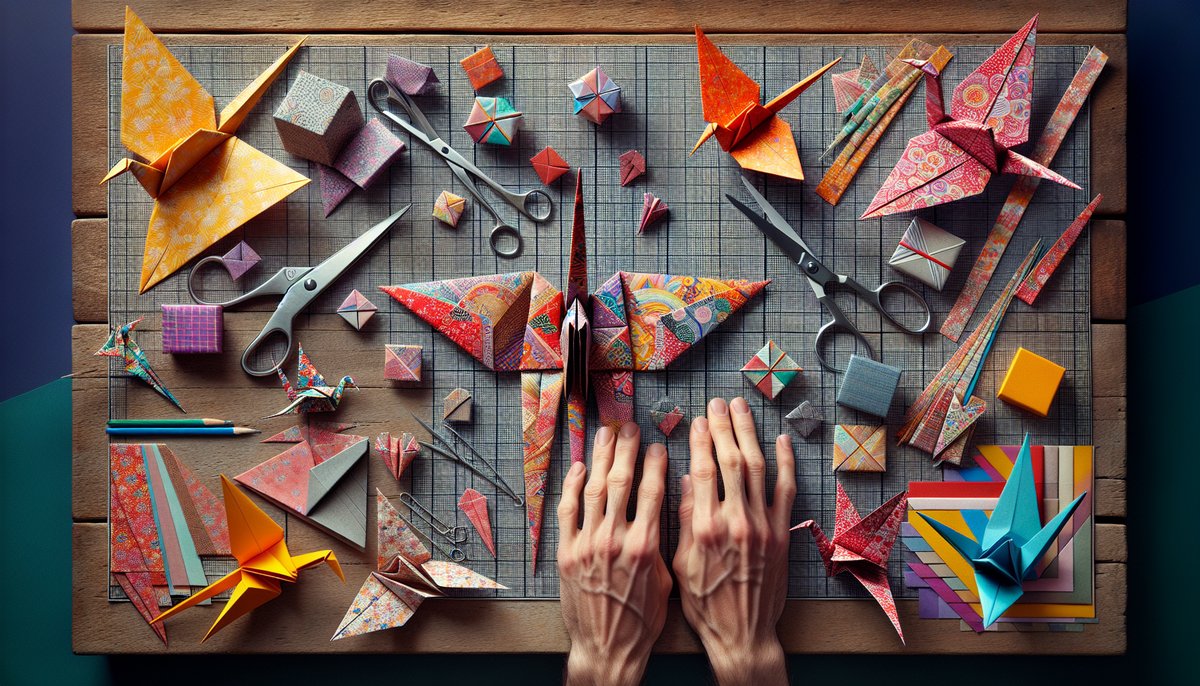
Origami on Video: Teaching Precision, Not Just Paper Folds
CraftsPaper Art

Origami on Video: Teaching Precision, Not Just Paper Folds

Origami clips saturate every corner of social media, but most serve up little more than hand movement and background music. What actually sets a valuable tutorial apart is ruthless clarity - creators who show every fold, name the maneuvers, and avoid hand-in-frame chaos. The best videos cut through the noise by teaching real technique, not just producing a recognizable animal.

@Origami Tutorial With YJ Hoffmann YouTube
Why this clip

YJ Hoffmann’s black cat tutorial stands out with relentless visual clarity. Each fold - diagonal, kite, squash, petal, reverse - is named and demonstrated without haste or ambiguity. This is textbook intermediate origami, distilled without condescension.

@_art_and_craft_ideas Instagram
Why this clip

This crane tutorial’s sequence is surgical: clear cuts, perfect squaring, and methodically executed base folds. The camera work gets out of the way so the action’s always visible. Few tutorials make the fundamental bird base this approachable without dumbing it down.

@origami world TikTok
Why this clip

‘Origami world’ leans into complex folding - pleats, squashes, and reverse folds create structure for a scorpion that’s more than a rectangular abstraction. The shaping of claws and tail is more evocative than most, though a few steps move a touch fast for close study.

@Coraubanne TikTok
Why this clip

This swallow unfolds with no wasted motion. The sequence is as close to canonical as you’ll find for a bird of this style, and the choice to show inside and outside reverse folds pays off. Less stylized than some, but that's a strength here.

@Paper Kawaii - Origami Tutorials YouTube
Why this clip

Paper Kawaii’s bow tutorial breaks from the animal-dominated pack. Integration of kirigami - actual cutting - makes for a real bow proportion, rather than a ‘just folded’ approximation. Practical tips for shaping lift it above generic 'cute' content.

@Art of Fold YouTube
Why this clip

The jumping spider is briskly paced, bordering on abrupt, but manipulates the square sheet into something identifiably spidery. There’s less guidance for the less-experienced hands, especially during cutting and shaping.

@Hi Origami TikTok
Why this clip

A slow-motion parrot tutorial is mercifully rare and genuinely effective for following the progression of inside reverse and pleat folds. Clarity remains high throughout, though the stopping to show cuts isn’t quite as granular as it could be.

@Alliy Moon YouTube
Why this clip

Shuzo Fujimoto’s cube, animated for every crease and pocket, is a neat reprieve from faux-3D models. The collapse-inflation moment is handled with enough close-up to demystify the critical transition - this model’s rarely this well-demonstrated outside long-form content.

@guitar_chiang Instagram
Why this clip

The Max Hulme angel gets a thorough visual breakdown, with Chinese overlays adding to the instructional density. Pleating and shaping are handled with more subtlety than often seen, though some moment-to-moment transitions would benefit from a slower hand.

@EASY ORIGAMI YouTube
Why this clip

The karambit knife brings assembly and gluing into the mix, which isn’t purist origami but gives newcomers a gratifying result. Segmentation clarifies what piece becomes what - too many tutorials jumble this, but here each component is treated with equal care.

What separates the best

Across these clips, a pattern emerges: the most satisfying tutorials make their technique visible, with no hidden gestures or jump cuts where mistakes hide. Creators like Hoffmann and _art_and_craft_ideas approach instruction as documentation, not theater. The black cat and crane tutorials stand out for honest pacing and transparency in process. In contrast, the scorpion and jumping spider demos sacrifice some clarity in favor of spectacle - choices that serve experienced folders but frustrate first-timers.

The cube video is rare for naming design credits, respecting both creator and audience intellect. When a clip acknowledges its source or design lineage, it signals you’re hearing from someone who actually folds outside the camera’s view. The inclusion of kirigami (bows, knives) marks a small but not insignificant divergence: these projects ask you to bring scissors or glue, opening up outcomes at the cost of traditionalist purity. Each approach draws its own audience.

It’s remarkable how few clips get animal shaping right - the swallow and angel being exceptions, with clear attention paid to proportion and subtleties like pleating, rather than angular generalizations. The real differentiator? Visual pacing that balances between showing the technique plainly and keeping the watcher engaged through each transformation.

If you care about folding well, not just finishing, pick a model that pushes your edge - maybe the cat for precision, or the cube for geometric control. Each disciplined repetition sharpens your eye for detail; that’s where real progress starts.